
SCTL RESEARCH PROJECTS
Current Studies
Stony Brook SPARK!
The SCTL is thrilled to be part of Stony Brook's involvement in the SPARK Study - the largest study of autism in the world!
To learn more about SPARK or participate through Stony Brook, please click here:
https://sparkforautism.org/stonybrook
With any questions, please email [email protected]!
To learn more about SPARK or participate through Stony Brook, please click here:
https://sparkforautism.org/stonybrook
With any questions, please email [email protected]!
Superflex Series Pilot Study
We are so excited to invite you to participate in our new study, the Superflex Series Pilot Study, to learn more about how the Social Detective/Superflex curriculum can help youth with autism with their social-emotional learning. This study will help us to create more effective and precise treatments for youth with autism while learning about the implementation of the Social Detective/Superflex curriculum.
We are recruiting elementary-school children with ASD. Please take a look at our flyer below for more information about how to participate in the study and contact us at [email protected] or 631-632-7857 for questions!
We are recruiting elementary-school children with ASD. Please take a look at our flyer below for more information about how to participate in the study and contact us at [email protected] or 631-632-7857 for questions!

| Superflex |
How Scientists View Science Communication Training - Pilot Study
The Social Competence & Treatment Lab (SCTL) in the Department of Psychology at Stony Brook University is conducting a pilot study in conjunction with the Alan Alda Center for Communication Science and George Mason University’s Department of Communication to better understand how scientists view science communication training and to facilitate the development of coding procedures and reliability.
We are recruiting graduate students, post-docs, and faculty members (18 years or older) to complete an online pilot research study. Check out the flyer below for more information and contact us at [email protected] or 631-632-7857 for questions!
We are recruiting graduate students, post-docs, and faculty members (18 years or older) to complete an online pilot research study. Check out the flyer below for more information and contact us at [email protected] or 631-632-7857 for questions!
| ALDA Study.pdf |
Questionnaire Study for Autistic Adults
SCTLers Elliot Keenan, a PhD candidate at UCLA and Ava Gurba, a master's student at Stony Brook, are conducting a research study examining sticky thinking (repetitive thinking), stimming (repetitive behaviors), and mental health in autistic adults. Participating in this study involves completing two 30 minute online surveys two weeks apart, consisting of several sets of multiple choice questions.
They are recruiting people who identify as autistic or as having autism (both official and self-diagnosed autistic individuals are included) and are aged 18+. Check out the flyer below for more information, and contact PhD Candidate Elliot Gavin Keenan at [email protected] for questions!
They are recruiting people who identify as autistic or as having autism (both official and self-diagnosed autistic individuals are included) and are aged 18+. Check out the flyer below for more information, and contact PhD Candidate Elliot Gavin Keenan at [email protected] for questions!

| Questionnaire Study |
Online Promoting Resilience in Teens with ASD (OPRITA)
We are happy to announce our newest research study Online Promoting Resilience in Teens with ASD (OPRITA) that compares two different computer activities that teach ideas that may be helpful for teens with ASD to improve coping and resilience.
This study involves two virtual Zoom “visits” where participants will answer questionnaires and complete an online activity which may improve emotional resilience and stress coping skills. Upon completion of the study participants will earn a $35 gift card.
We are recruiting children ages 11-16 with ASD! Check out the flyer below for more information, and contact us at [email protected] or 631-632-7857 for questions!
This study involves two virtual Zoom “visits” where participants will answer questionnaires and complete an online activity which may improve emotional resilience and stress coping skills. Upon completion of the study participants will earn a $35 gift card.
We are recruiting children ages 11-16 with ASD! Check out the flyer below for more information, and contact us at [email protected] or 631-632-7857 for questions!
| OPRITA |
Patterns of EEG in Daily Life in ASD Youth (PEDAL - ASD)
We are excited to invite you to participate our new study, the Patterns of EEG in Daily Life in ASD Youth (PEDAL - ASD) to study brainwave (EEG) patterns in youth with autism and relate these findings to autistic behavior. This study consists of four visits and participants will receive $100 compensation upon completion.
We are recruiting youth aged 18 months to 17 years old diagnosed with ASD by an autism specialist, and their parents/legal guardians. Please take a look at our flyer below for more information about how to participate in this exciting study and contact us at [email protected] or 631-632-7857 for questions!
We are recruiting youth aged 18 months to 17 years old diagnosed with ASD by an autism specialist, and their parents/legal guardians. Please take a look at our flyer below for more information about how to participate in this exciting study and contact us at [email protected] or 631-632-7857 for questions!
| PEDAL - ASD |
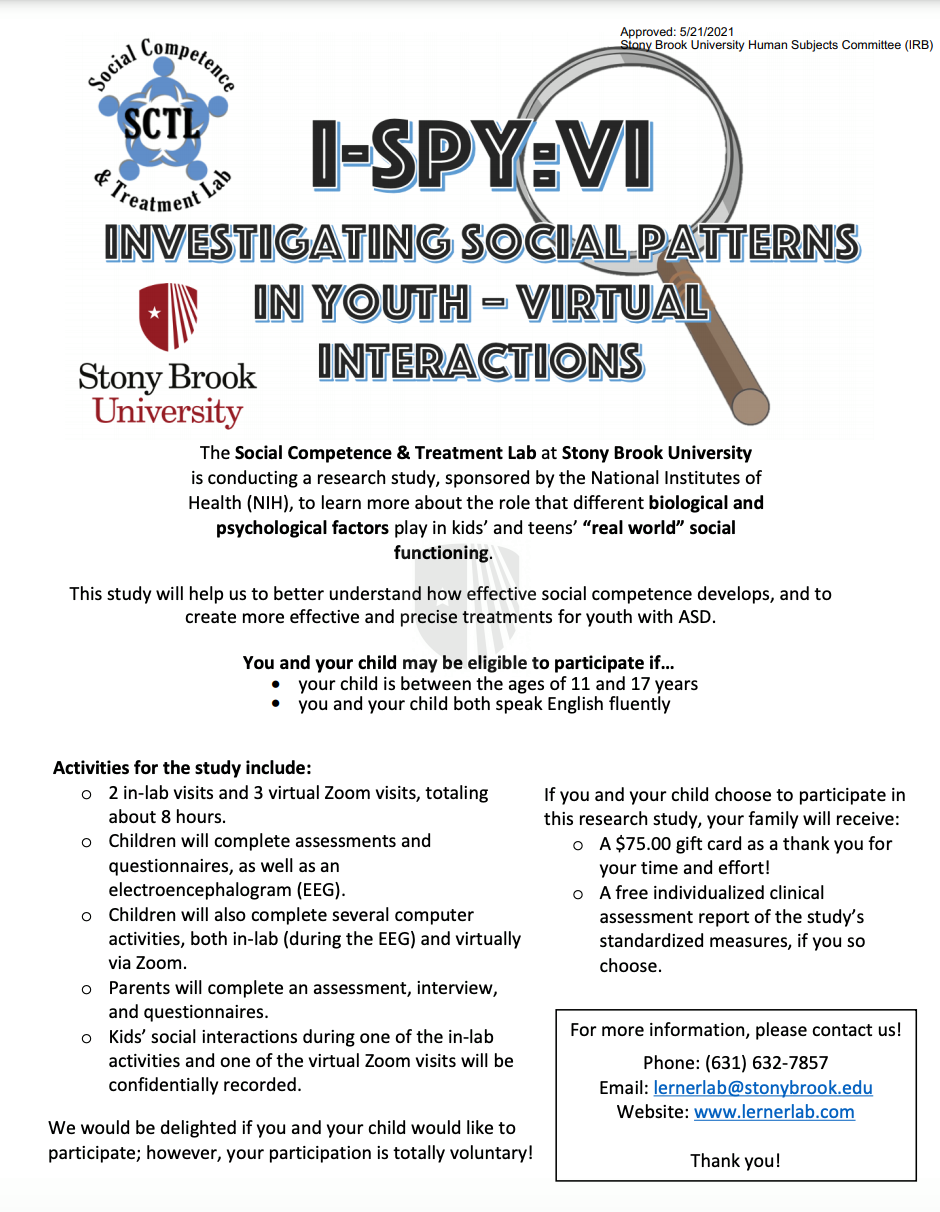
Investigating Social Patterns in Youth - Virtual Interactions (I-SPY: VI)
We are conducting a research study to learn more about the role that different factors play in kids’ and teens’ “real world” social functioning. This study consists of a few short visits to our lab, one of which includes a virtual game night! This study will help us to better understand how effective social competence develops, and to create more effective and precise treatments for youth with ASD.
We are recruiting children ages 11-17 with and without ASD! Check out one of the flyers below for more information about how to get involved, and contact us at [email protected] or 631-632-7857 for questions!
We are recruiting children ages 11-17 with and without ASD! Check out one of the flyers below for more information about how to get involved, and contact us at [email protected] or 631-632-7857 for questions!
|
For families of children 11-17 with ASD:

|
For families of children 11-17 without ASD:
| ||||
For these and other ASD-relevant studies being conducted through the Stony Brook Psychiatry Autism Clinic, please click here.
Upcoming Studies
Upcoming studies will focus on lab-based games and tasks to improve understanding of processes involved in social interaction, as well as survey research exploring familial processes in families with and without ASDs.
As we begin to recruit for these studies, additional information will be available here. In the meantime, feel free to contact us at [email protected]! We'd be happy to answer questions you have, and you can ask to be added to our contact list to receive periodic updates as new opportunities to participate become available!
As we begin to recruit for these studies, additional information will be available here. In the meantime, feel free to contact us at [email protected]! We'd be happy to answer questions you have, and you can ask to be added to our contact list to receive periodic updates as new opportunities to participate become available!
Intervention Studies
We are engaged in a series of ongoing and new studies examining different approaches to help
children and teens with ASD engage in rich social connection, with the goal of understanding
what works best, and for whom.
children and teens with ASD engage in rich social connection, with the goal of understanding
what works best, and for whom.
